
Members of the HUN-REN-SZTE Stellar Astrophysics Research Group and the Baja Astronomical Observatory of the University of Szeged in close collaboration with several international researchers using the observations of the TESS (Transiting Exoplanet Survey Satellite) space telescope, and then supplementary photometric and spectroscopic observations, have shown that the object located in the Cygnus stellar constellation, catalogued under the name of TIC 120362137, is actually a quadruple star system in which three stars, somewhat more massive and hotter than the Sun, are located within a region smaller than Mercury’s orbit around the Sun, while the fourth, Sun-like star orbits the center of mass of the inner triple star system within a distance equaling that of the main asteroid belt of our Solar system (which is located between the orbits of Mars and Jupiter). The researchers have also determined that the quadruple stellar system is approximately one and a half billion years old, and that the inner three stars are going to merge into a single white dwarf star in just about 300 million years. The scientific article describing the research has been published in one of the most prestigious interdisciplinary scientific journals, Nature Communications on March 3, 2026.
The TESS space telescope, which primarily searches for extrasolar planets by the transit method (i.e. looks for the temporary, small decreases in the brightness of stars caused by planets passing in front of them), departed on April 18, 2018 from the Cape Canaveral Space Force Station in Florida and orbits around our Earth in about 13.5 days on a highly eccentric, so-called Moon-synchronous orbit. Its four onboard cameras observe a 24° x 96° sized area of the sky at the same time. It follows the same area for two consecutive orbits (so approximately for 27 days, one lunar month of time), continuously recording the apparent brightness of millions of stars, then it turns to another area (i. e. sector) of the sky. (On larger northern and southern ecliptic latitudes, the sectors can significantly overlap enabling long-term observations, too.) This way, the space telescope photographs most of the entire sky in two years time. Naturally, these exceptionally precise space datasets are suitable to detect not just transits (eclipses) of exoplanets, but a remarkably wide range of, often not expected, possibly completely new brightness variations of many stars can be also observed.
The research group, led by Tamás Borkovits (HUN-REN-SZTE Stellar Astrophysics Research Group and Baja Astronomical Observatory of the University of Szeged) and Saul A. Rappaport (professor emeritus at the MIT Kavli Institute for Astrophysics and Space Research), had already discovered and analysed many remarkable variable stars, mostly multiply eclipsing, compact hierarchical triple star systems based on the observations of the TESS space telescope. This is how the research group became aware of the object named TIC 120362137 that was observed by TESS in nine observational sectors between 2019 and 2024. The brightness of the object decreased by 8-10% for a few hours in about every one and a half days indicating that it consists of at least two stars that orbit each other in P1=3.28 days, and we see their orbit nearly edge-on, which results in two eclipses (i. e. fadings) for the observer during every orbit. Moreover, in every 26-27 days, 1-2 days long extra fadings could be observed in the light curves, and their shapes confirmed that there is also a third star in the system with a remarkably short (but not record braking) P2=51.3 days long period. Due to the gravitational pull of this third stellar component, this 51.3 days long period also appeared in the eclipse timing variations of the inner binary star that could be observed and interpreted quantitatively based on the analytical perturbation formalism developed by the research group leader during the last two decades.
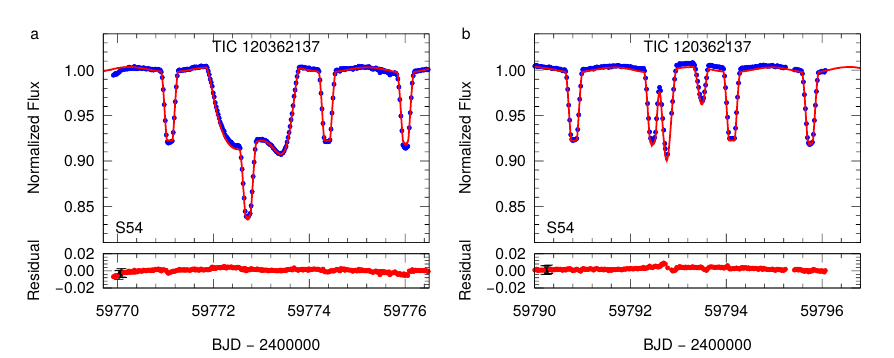
Figure 1: An excerpt of the full light curve (blue points) observed by TESS in the 54th sector (S54) along with the light curve model (red line). The 1-2 hours long eclipses produced by the inner eclipsing binary are well observable, every second eclipse having a flat bottom, showing that at those times the larger star completely obscures the smaller one. On the left panel (a), only one, approximately 2 days long third body eclipse can be seen, showing that at that time the two stars of the eclipsing binary obscured the third component at the same time, while on the right panel (b) two separate extra fadings can be seen, showing that this time the third star sequentially obscured the two stars of the eclipsing binary. On the lower panels, the residual curves are shown.
At this point, Guillermo Torres from the Harvard & Smithsonian Center for Astrophysics has joined the project, who obtained numerous spectra about the object using the 1.5m mirror reflector telescope of the Fred Whipple Observatory at Arizona equipped with the TRES spectrograph (which was designed and built by Gábor Fűrész who graduated from the University of Szeged). In parallel, additional spectroscopic observations have been taken with a Slovakian, with a Bulgarian, and also with a Hungarian spectrograph installed at the Piszkéstető Observatory of the HUN-REN Research Center for Astronomy and Earth Sciences Konkoly Thege Miklós Astronomical Institute, while supplementary photometric observations have been observed by members of the Baja Astronomical Observatory of the University of Szeged, and the Gothard Astrophysical Observatory of the Eötvös Loránd University using two identical 0.8m reflector telescopes. Additionally, numerous other, mainly Czech, professional and amateur astronomers have taken and sent newer and newer photometric observations. All of these supplementary spectroscopic and photometric observations along with newer observations of TESS have shown that a compact triple star model is not adequate to describe the object’s behavior. Both the radial velocity curves derived from spectroscopic observations, and the timing variations of the binary and third body eclipses from photometric observations, indicated that an additional fourth star has to be present in the system. G. Torres was the first who identified the spectral lines of this fourth star in the best quality TRES spectra, and he also determined the orbital period of this star which (after some subsequent correction) turned out to be 1045.5 days long.
By this means, this is the shortest outer period quadruple system with 3+1 hierarchy and also the only one in which the spectral lines of all four stars could be separated.
In addition, with this orbital period, the variations in the eclipse times and in the occurrence times of the extra eclipses had become easily explainable. This way, the research group was able to perform a full spectro-photodynamical analysis of this exceptional quadruple system, which includes the numerical integration of the motion of the four stars (accounting for their mutual gravitational perturbations), the precise modeling of the total brightness variations (eclipses), the radial velocity curves, and the complex spectral energy distribution (i.e. the optical brightnesses measured through different passbands) of the quadruple system. This led to an accurate determination of the masses, radii, temperatures, ages, and (photometric) distances of the four stars along with numerous parameters of their orbits.
The research group had concluded that the all three stars of the inner triple system are more massive and hotter than our Sun and located within a region that is smaller than the average distance of planet Mercury from the Sun, while the fourth, outer star is very similar to our Sun and its distance from the center of mass of the inner compact triple star barely exceeds the average distance of planet Mars from the Sun.
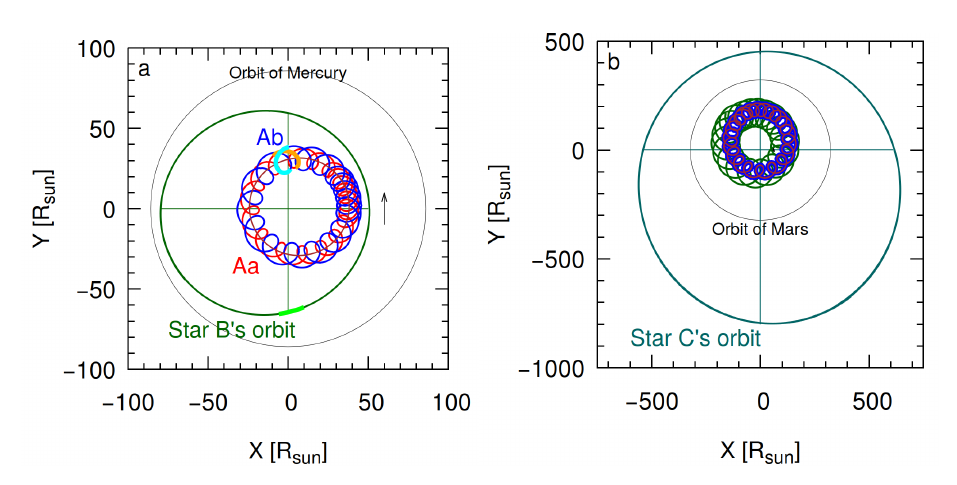
Figure 2: Architectures and true measures of the TIC 120362137 quadruple star system. Left panel (a): The orbit of the inner triple system around the fixed center of mass of the triple. The red and blue curves denote the orbits of the components (Aa and Ab) of the inner eclipsing binary. We also denoted the orbit of the center of mass of these two stars with brown line. The green curve denotes the orbit of the third component (B). For comparison, we show Mercury’s average distance from the Sun with a thin grey line. On the three stellar orbits, the widened arcs denote the positions of the tree stars in the first observational TESS sector, sector 14, during the third body eclipse observed in the summer of 2019. (The observer is located along the positive Y-axis.) Right panel (b): The quadruple system’s true, full three-dimensional motion around the center of mass of the four stars. For comparison, we also show the average Sun-Mars distance. The units are given in Solar radii (R_sun) in both panels.
The accurately determined astrophysical and dynamical parameters have also enabled a modelling of the future evolution of the quadruple star system. The researchers have found that, following multiple red giant phases and after substantial mass losses, the stars of the inner triple are going to merge into a single white dwarf likely on an astronomically short timescale of only about 300 million years.
The scientific article covering this research in detail is available at the following link: https://www.nature.com/articles/s41467-026-69223-4