

Weight loss on its own can improve many metabolic markers, but does it also matter where the calories consumed come from? According to a new randomized clinical trial, it does: although participants on three different diets lost roughly the same amount — about 10% of their body weight — liver fat metabolism and insulin sensitivity changed differently.
The study, published in Cell Metabolism, compared a very low-carbohydrate ketogenic diet, a Mediterranean diet, and a very low-fat, plant-based diet. The strongest changes in liver metabolism were observed with the ketogenic diet.
However, the trial was small: 55 people were randomized, and 42 completed it and were included in the main analysis. Moreover, the participants were not average overweight individuals but obese adults with prediabetes and fatty liver disease. The results therefore apply primarily to this specific patient group.
Participants’ average age was 43, and their initial BMI was close to 39 kg/m². Over roughly five months, all three groups achieved about a 10% reduction in body weight.
One strength of the study is that dietary differences were controlled unusually strictly: the researchers provided all the food, and participants met with a dietitian weekly. Reported dietary adherence exceeded 95% in every group.
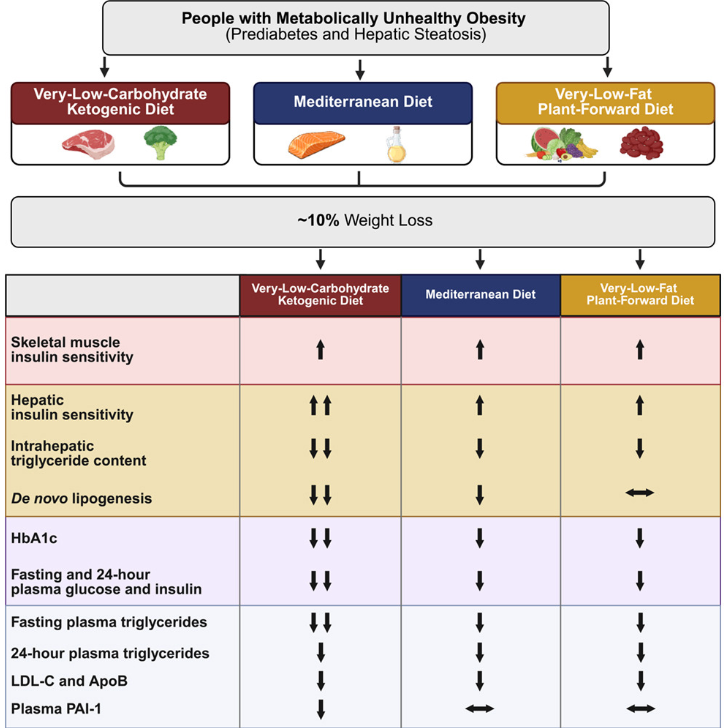
Weight loss alone dramatically improved metabolism. Skeletal muscle insulin sensitivity improved by about 50% on all three diets.
The liver, however, told a different story. Liver insulin sensitivity improved in all three groups, but the change was two to three times greater with the ketogenic diet than with the other two diets.
Liver triglyceride content — essentially the fat accumulated in the liver — decreased by 67% in the ketogenic group, compared with about 45% with the Mediterranean and plant-based diets.
This is notable because the weight loss was similar across groups. The difference suggests that the macronutrient composition of the diet can influence certain metabolic processes somewhat independently of the amount of weight lost.
With the ketogenic diet, 24-hour blood glucose exposure decreased by about 20%, compared with roughly 8% for the other two diets. The change in insulin levels was even more striking. The 24-hour insulin exposure dropped by 74% with the ketogenic diet, 44% with the Mediterranean diet, and 27% with the very low-fat, plant-based diet.
In the ketogenic group, fasting blood glucose and insulin, new fat synthesis in the liver, and several lab markers associated with insulin resistance all decreased to a greater degree.
Resolution of prediabetes was observed in 50% of participants in the ketogenic group, compared with 29% on the Mediterranean diet and 7% on the plant-based diet.
This last finding, however, should be interpreted with particular caution. Aside from the two predefined primary insulin-sensitivity endpoints, the other results were exploratory and were not corrected for the large number of statistical comparisons performed. In such a small trial, this makes it easier for seemingly striking differences to arise by chance.
Not every marker favoured the ketogenic diet. So, the picture is not that the ketogenic diet was “better” in every respect.
No significant difference was found among the three diets in LDL cholesterol, apolipoprotein B, or 24-hour triglyceride levels.
The ketogenic diet also produced a distinctive hormonal response. Glucagon levels rose by 52%, while they fell by roughly 30–40% with the other two diets. As a result, the glucagon-to-insulin ratio more than tripled in the ketogenic group.
This illustrates that the three diets didn’t simply represent three different routes to the same weight loss: metabolism adapted to entirely different hormonal environments.
No serious adverse events occurred in any of the groups during the trial.
One of the study’s most important strengths is that it was largely able to control for weight loss and dietary adherence. This is a difficulty in many earlier diet studies, because if one group loses more weight, it becomes impossible to determine whether the metabolic improvement was caused by the diet itself or simply by the greater weight loss.
In this study, however, a similar reduction in body weight was accompanied by different metabolic responses.
At the same time, general nutritional recommendations cannot be drawn from 42 evaluated participants. Nor does the study show whether these laboratory and metabolic changes translate, in the longer term, into fewer heart attacks, less diabetes, less liver disease, or fewer deaths.
It also remains unclear whether true ketosis is necessary to achieve the beneficial liver effect, or whether a more moderate carbohydrate reduction would produce a similar result. Nor do we know whether the same would hold true if someone stopped losing weight and simply maintained their body weight.
Reference: Petersen M, Smith G, Farabi S, et al. Effect of diet macronutrient content on the cardiometabolic response to weight loss: a randomized clinical trial. Cell Metab. 2026.
https://www.cell.com/cell-metabolism/fulltext/S1550-4131(26)00293-7